
Recap #cTENcf Birthday Bash Hanoi: From Vietnam to the World, Contributing to Kubernetes and Earning the Linux Foundation Scholarship
Nobody starts as a Kubernetes reviewer. I started with typos in the docs, and the same trail of small, public contributions is what won me a Linux Foundation scholarship.
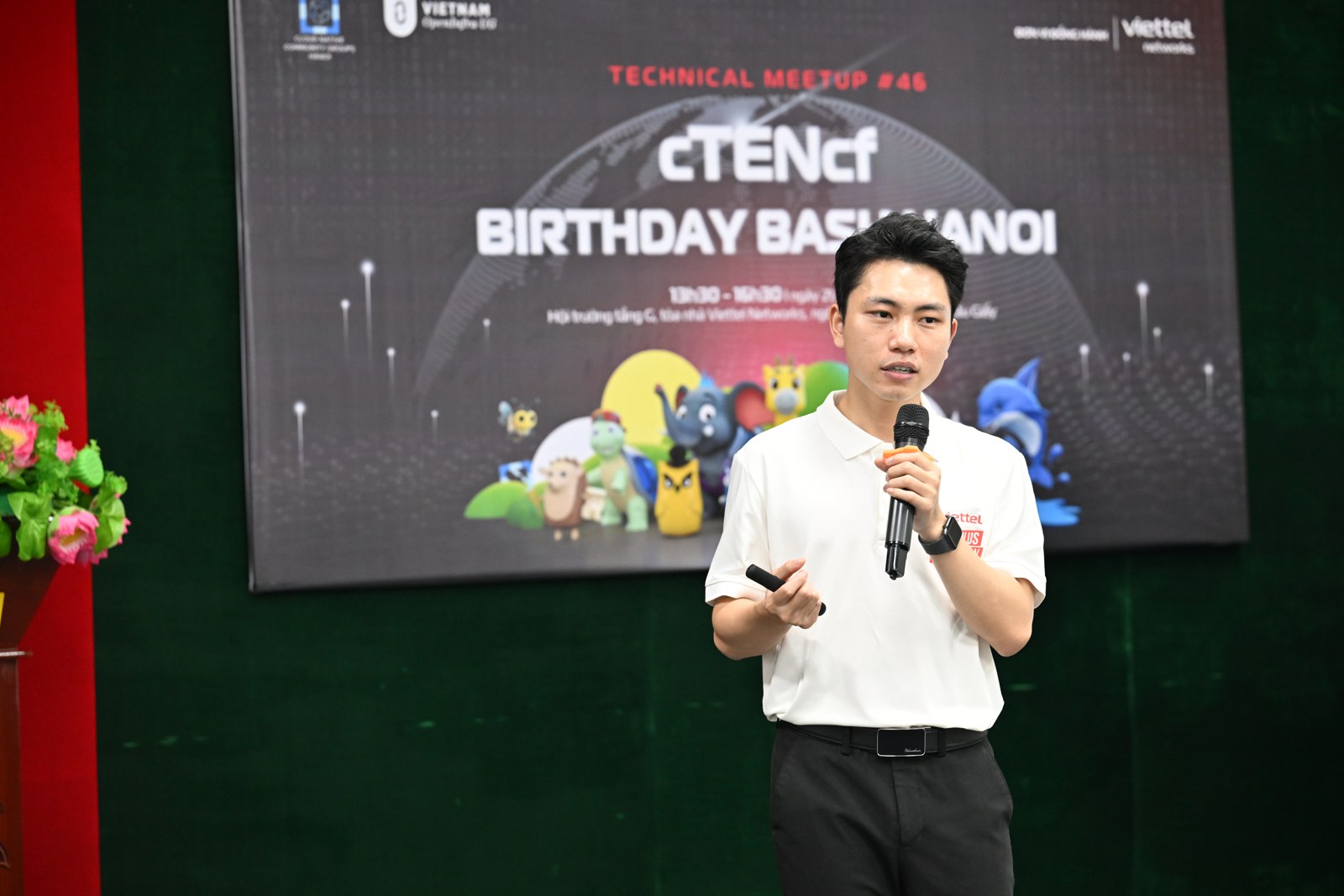
Contributions from Vietnam get noticed. Not because they’re big, but because they’re public and they keep coming. That was the point of my talk at #cTENcf Birthday Bash Hanoi on 21 September 2025, the Cloud Native Hanoi and VietOpenInfra meetup for CNCF’s tenth birthday.
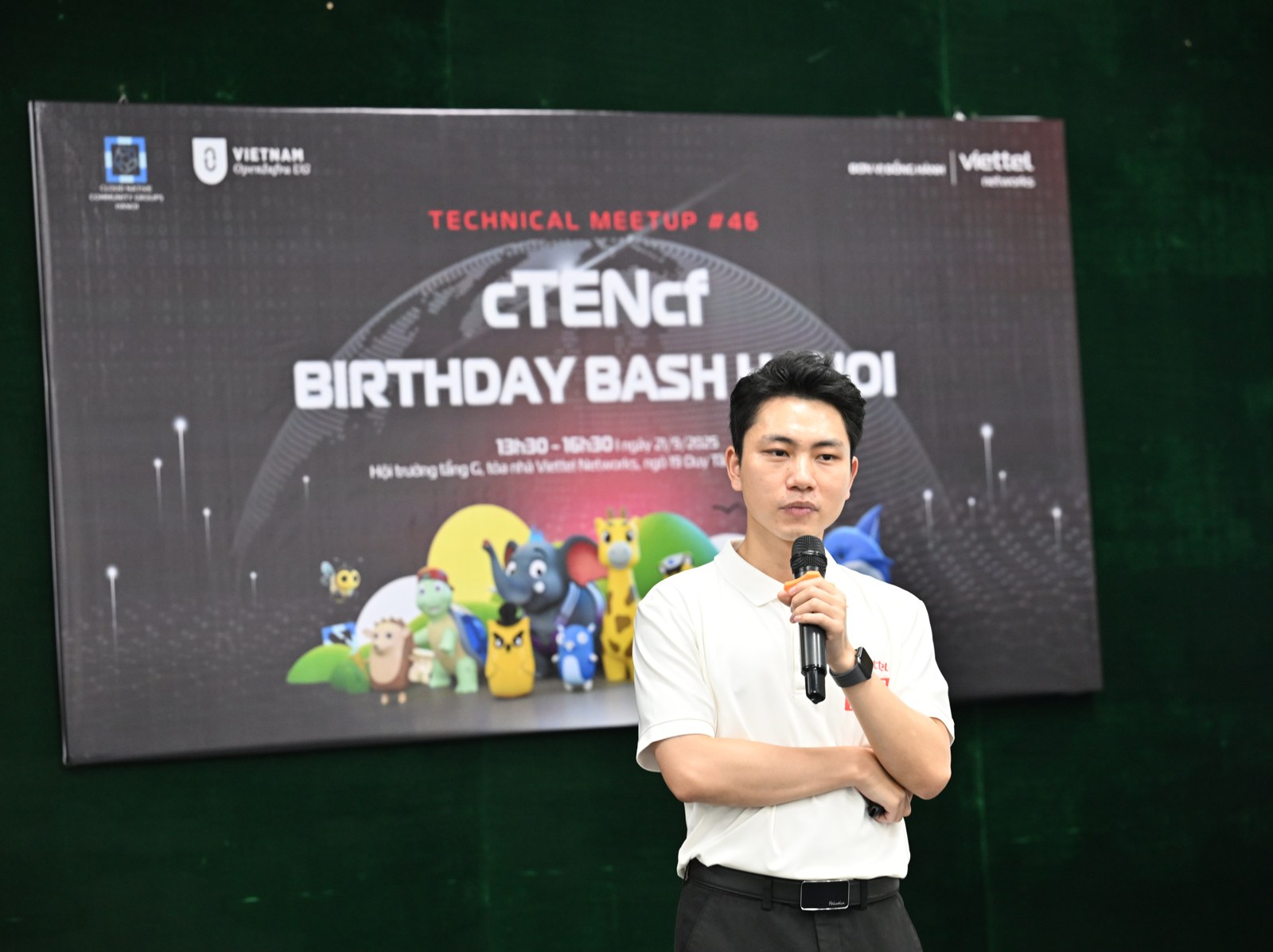
The talk had three parts: how I got into open source at all, how I went from Kubernetes user to reviewer, and how that record turned into a 2025 Linux Foundation Training (LiFT) scholarship.
It started with a T-shirt
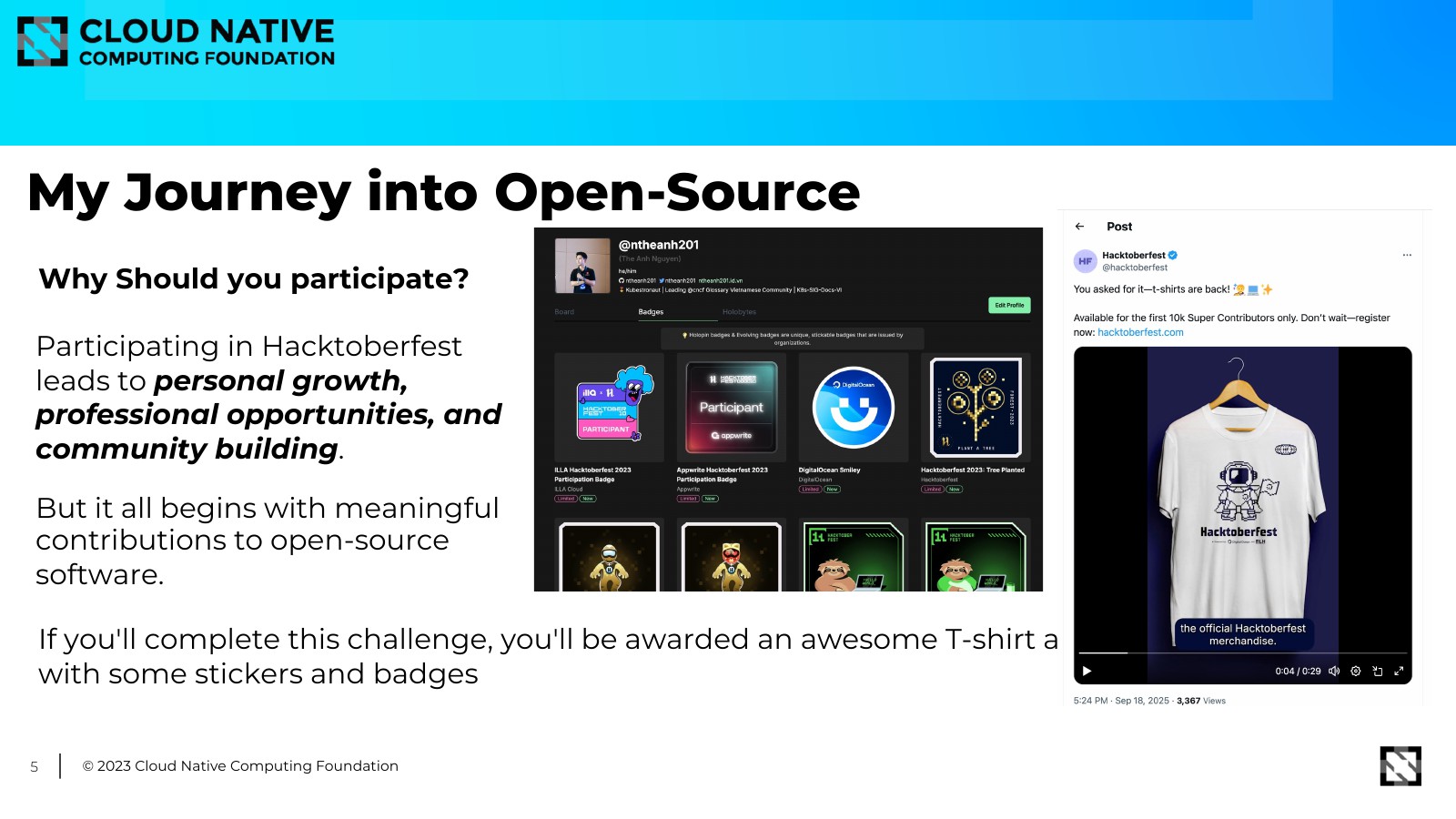
My first real push into open source was Hacktoberfest, the contribution challenge that runs every October. Finish it and you get a T-shirt and some stickers. That’s a modest reason to start, and it worked.
I picked Apache Traffic Control, an open source CDN under the Apache Software Foundation, because it was close to my day job. It had an active community and plenty to do: bugs, dashboards, monitoring, new features.
It wasn’t easy. One pull request, migrating the dynamic scripted Grafana dashboards to Scenes, ended at 25 commits, 58 files changed and 39 review comments. It was opened on 24 January 2024 and merged on 28 February, after weeks of review and rework.
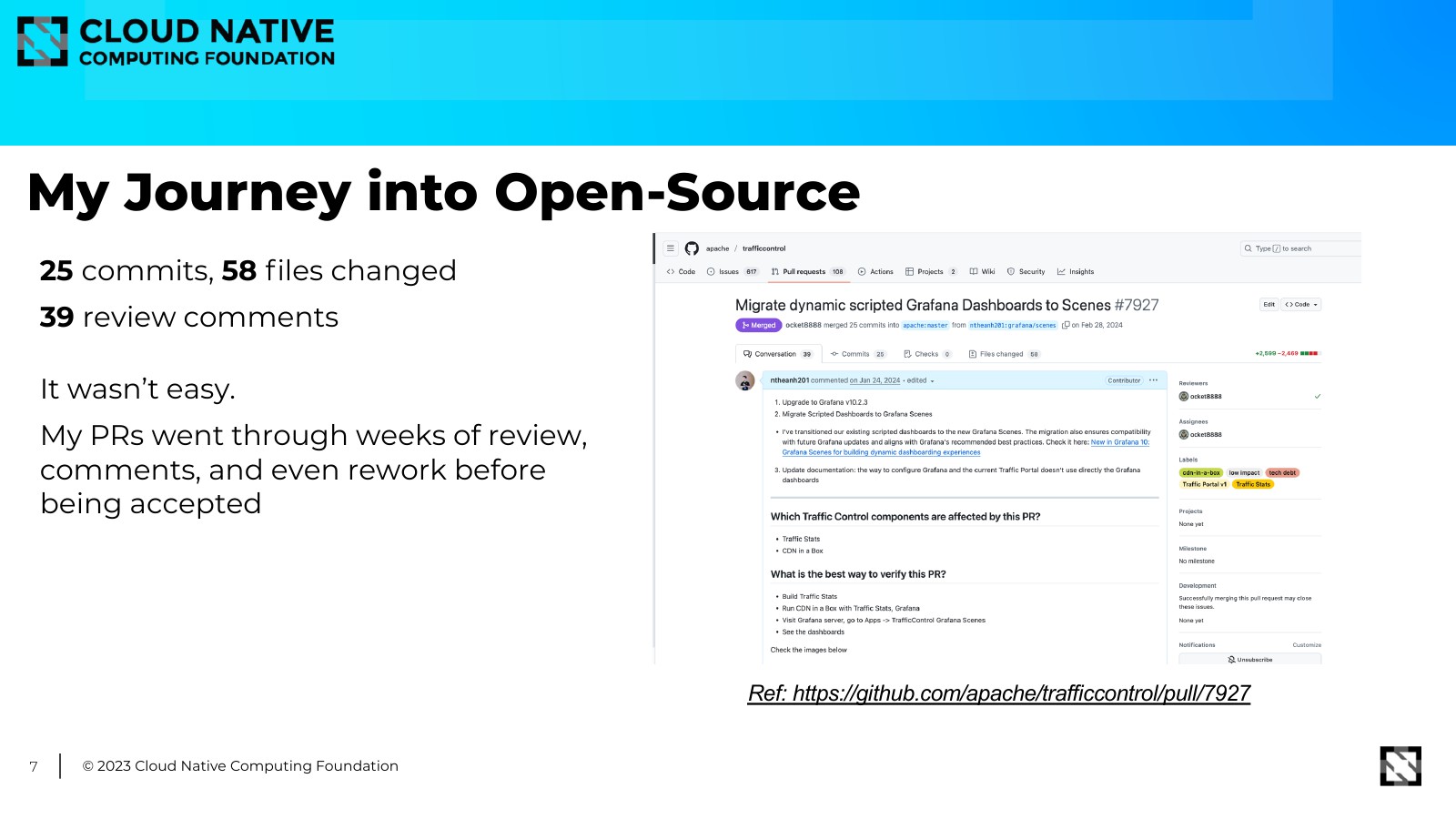
In total I opened 21 pull requests to Traffic Control, and 12 of them were merged. Code, bug fixes, docs and tutorials, helping other contributors: all of it counts. “Start small, grow global” was the line on that slide, and I still think it’s the right order.
From user to reviewer, in three steps
My Kubernetes story didn’t start with contributing. It started with running a production cluster for a connected-car platform, about 80 servers. That was my first real exposure: deploying, troubleshooting, keeping it stable. I was a user long before I was a contributor, and I think that’s the right order too.
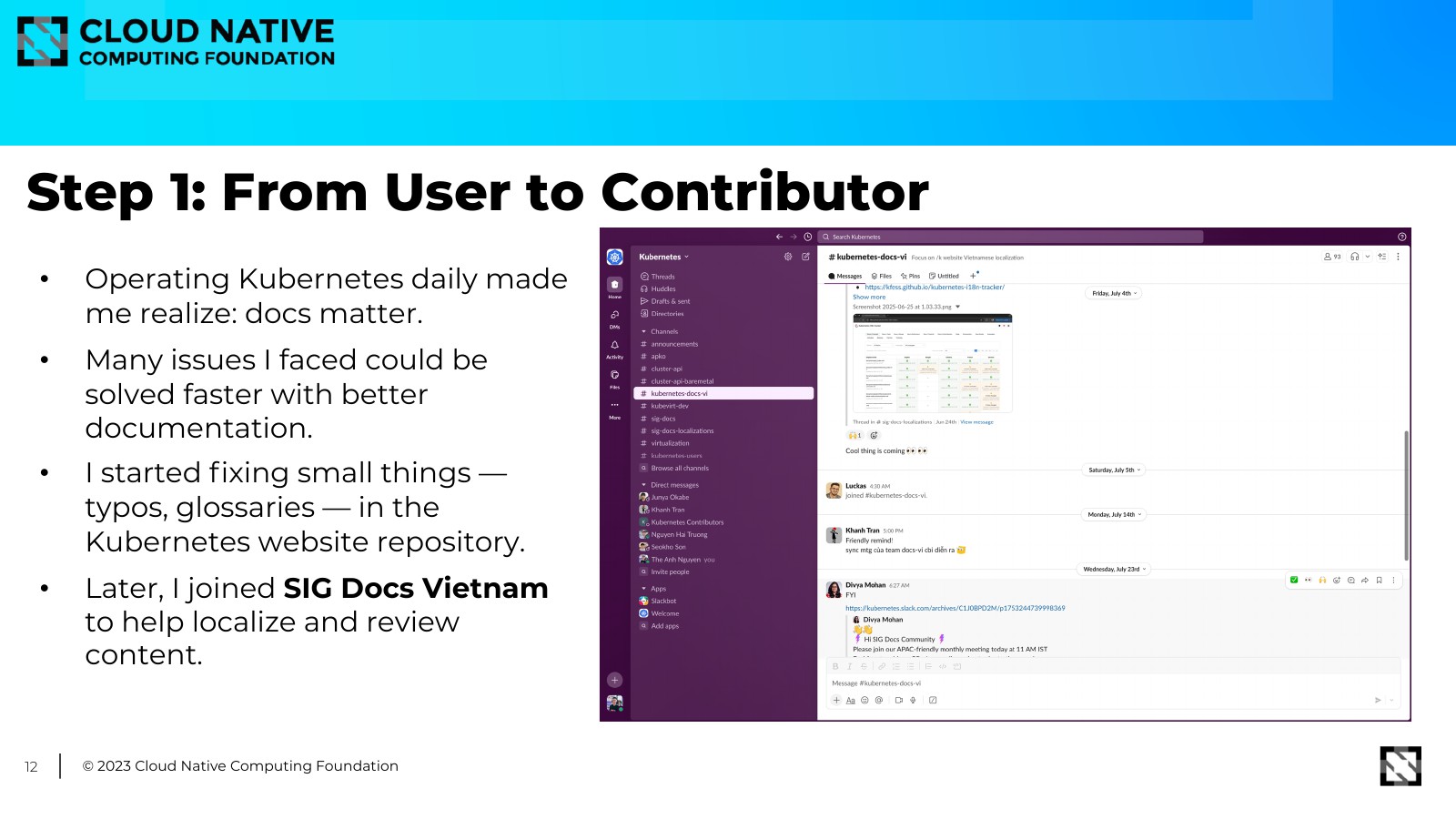
Step 1: user to contributor. Operating Kubernetes every day made me realise how much the docs matter. Many of the problems I hit would have been solved faster with better documentation. So I started fixing small things on the kubernetes/website repo: typos, glossary entries. Later I joined SIG Docs Vietnam to localise and review content.
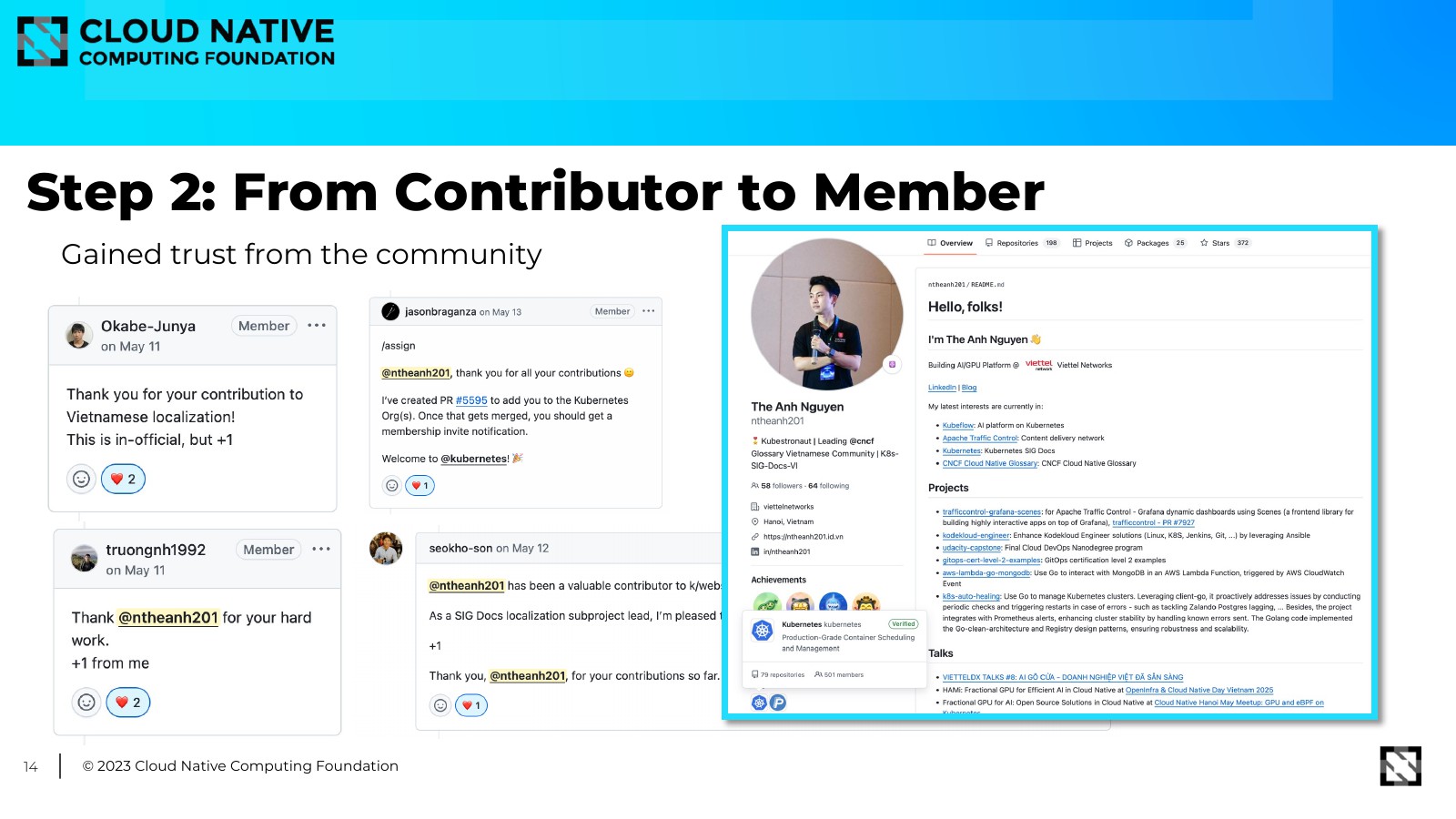
Step 2: contributor to member. I kept contributing to the docs, reviewed PRs, joined discussions and went to SIG Docs meetings. In May 2025 I asked to join the Kubernetes org, and community members who had seen the work gave their +1.
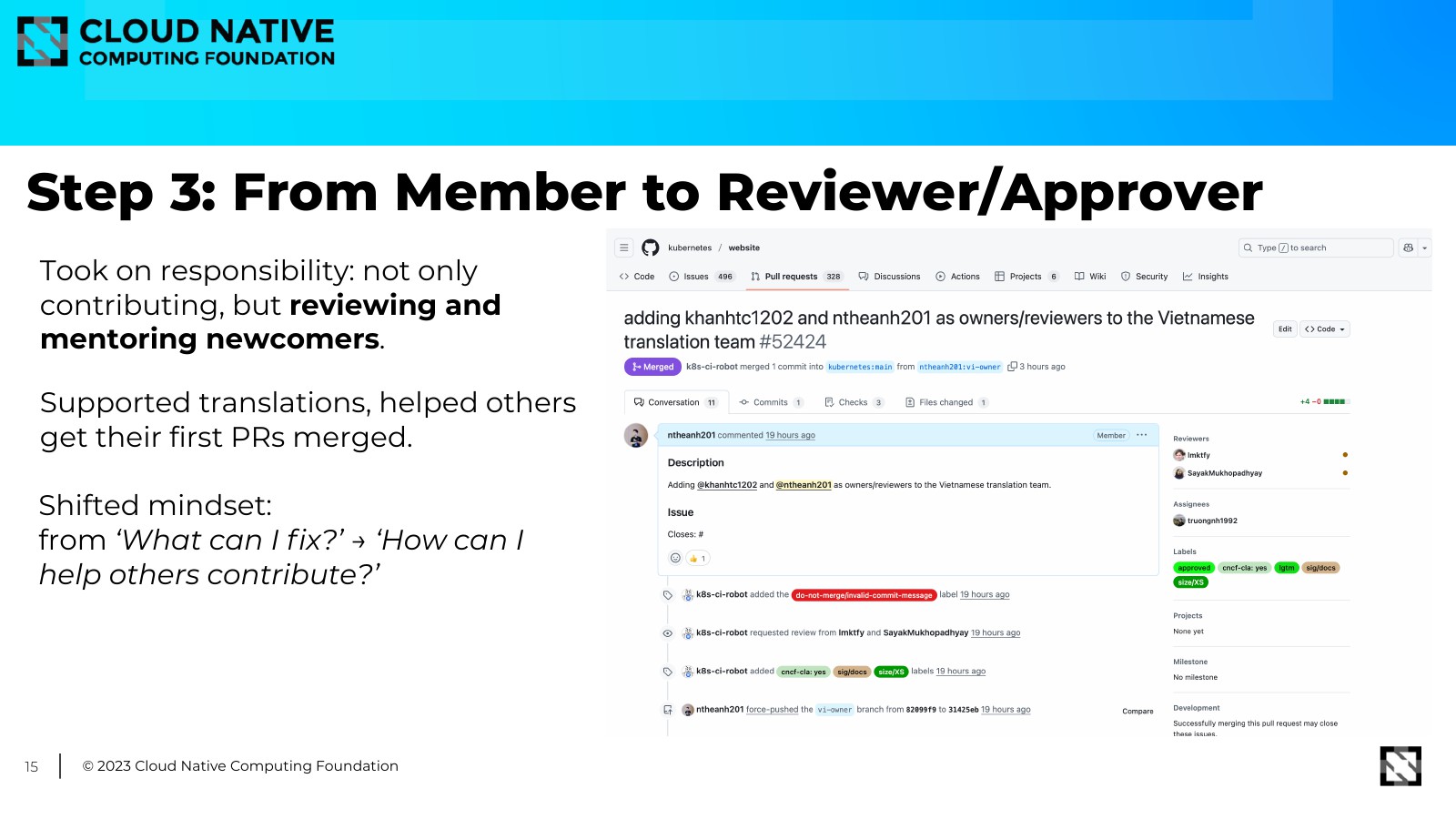
Step 3: member to reviewer. At this point the responsibility changes. It’s less about contributing and more about reviewing, and helping newcomers get their first PR merged. The day before the talk, a PR adding me as a reviewer and owner of the Vietnamese localisation team was merged. The question I ask myself changed from “what can I fix?” to “how can I help others contribute?”
Not all contributions are code
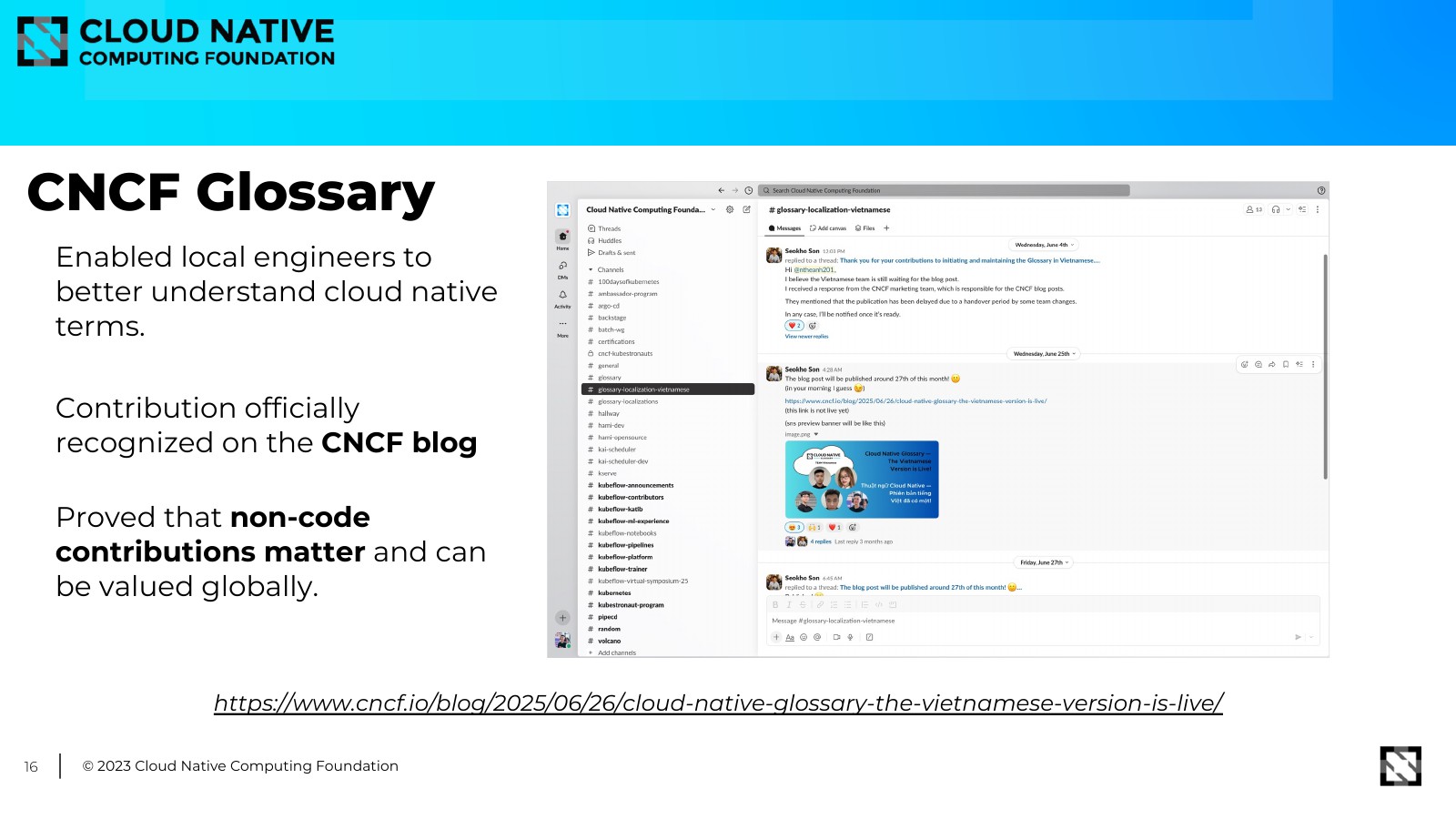
Not all of it was code. I led the Vietnamese localisation of the Cloud Native Glossary, so engineers here can read cloud native terms in their own language. The CNCF blog announced it in June 2025: Cloud Native Glossary: the Vietnamese version is live. Translation and docs are real contributions, and they’re valued globally.
If you’re looking for somewhere to start, CLOtributor searches CNCF projects for issues that suit a first contribution.
The scholarship
Every year the Linux Foundation awards 500 Shubhra Kar Linux Foundation Training (LiFT) scholarships across 16 categories, from Open Source Newbie to Cloud Champion. I applied for two reasons. Advanced Kubernetes training and certifications are expensive, and I wanted to go deeper. And I wanted to give something back to the community here.
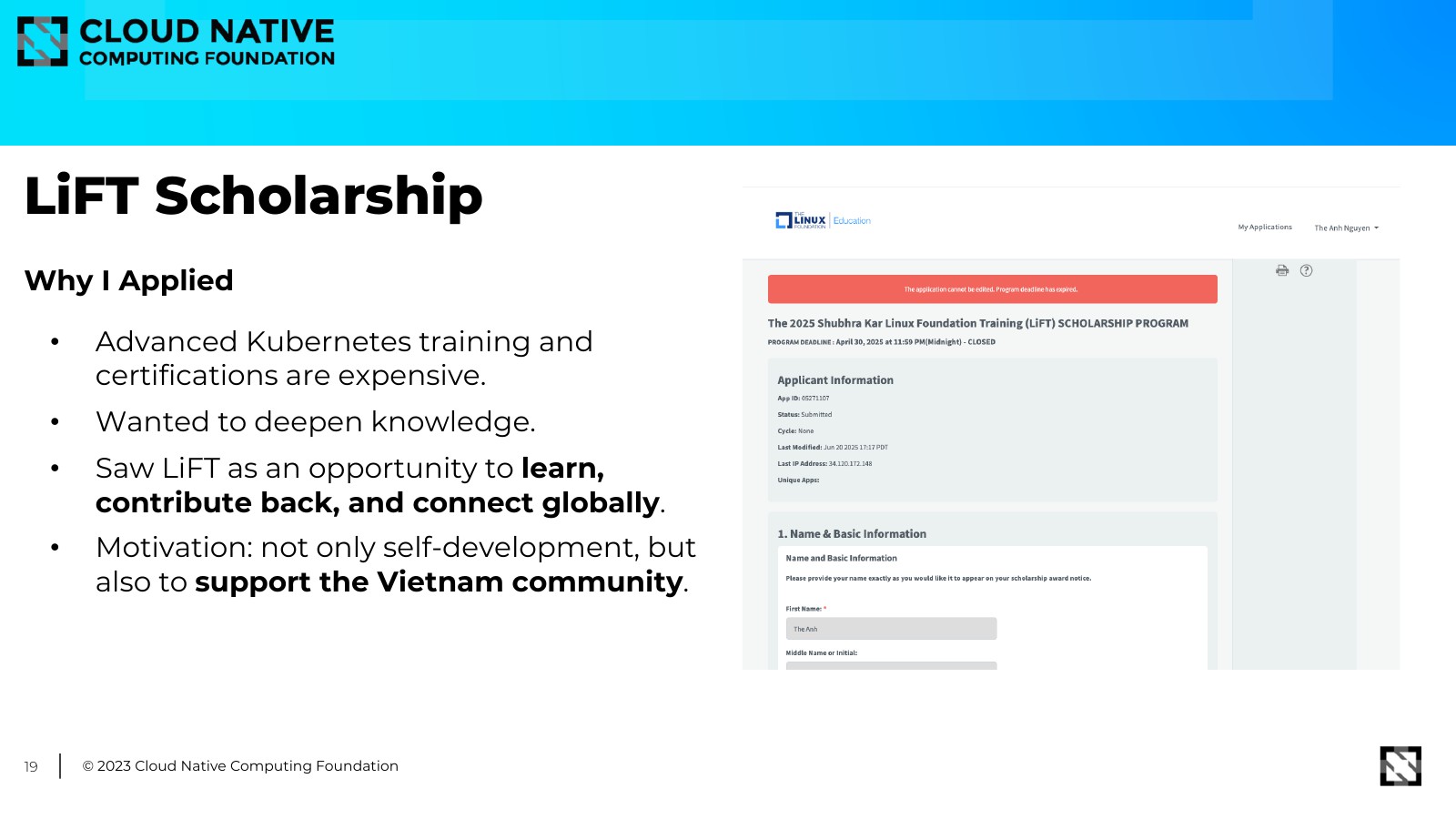
The form asks four questions. These are the answers I gave, and the tip I’d pass on for each:
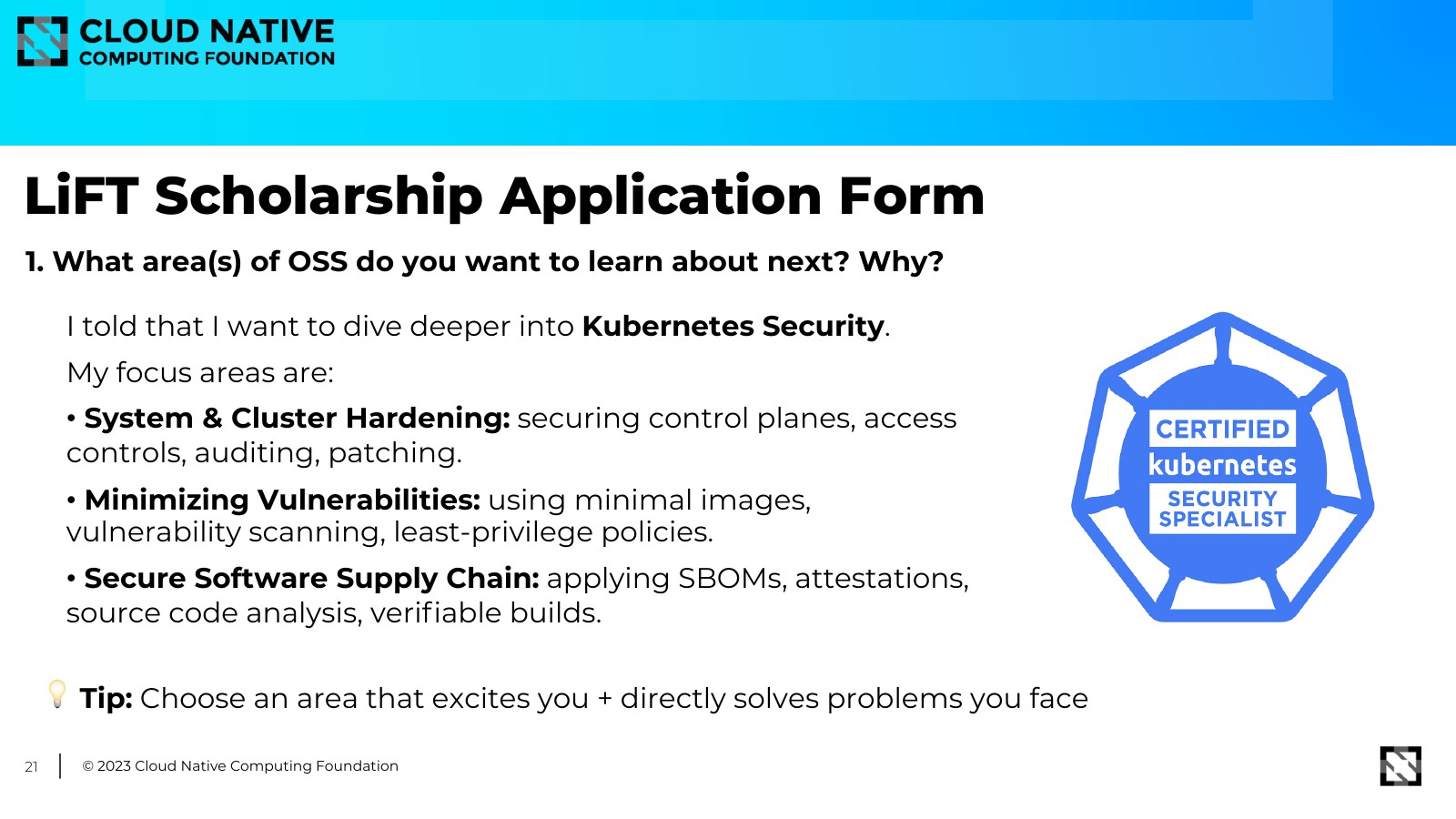
- Which area of open source do you want to learn next, and why? Kubernetes security: cluster hardening, fewer vulnerabilities, and the software supply chain (SBOMs, attestations, verifiable builds). Tip: pick an area that excites you and solves a problem you actually have.
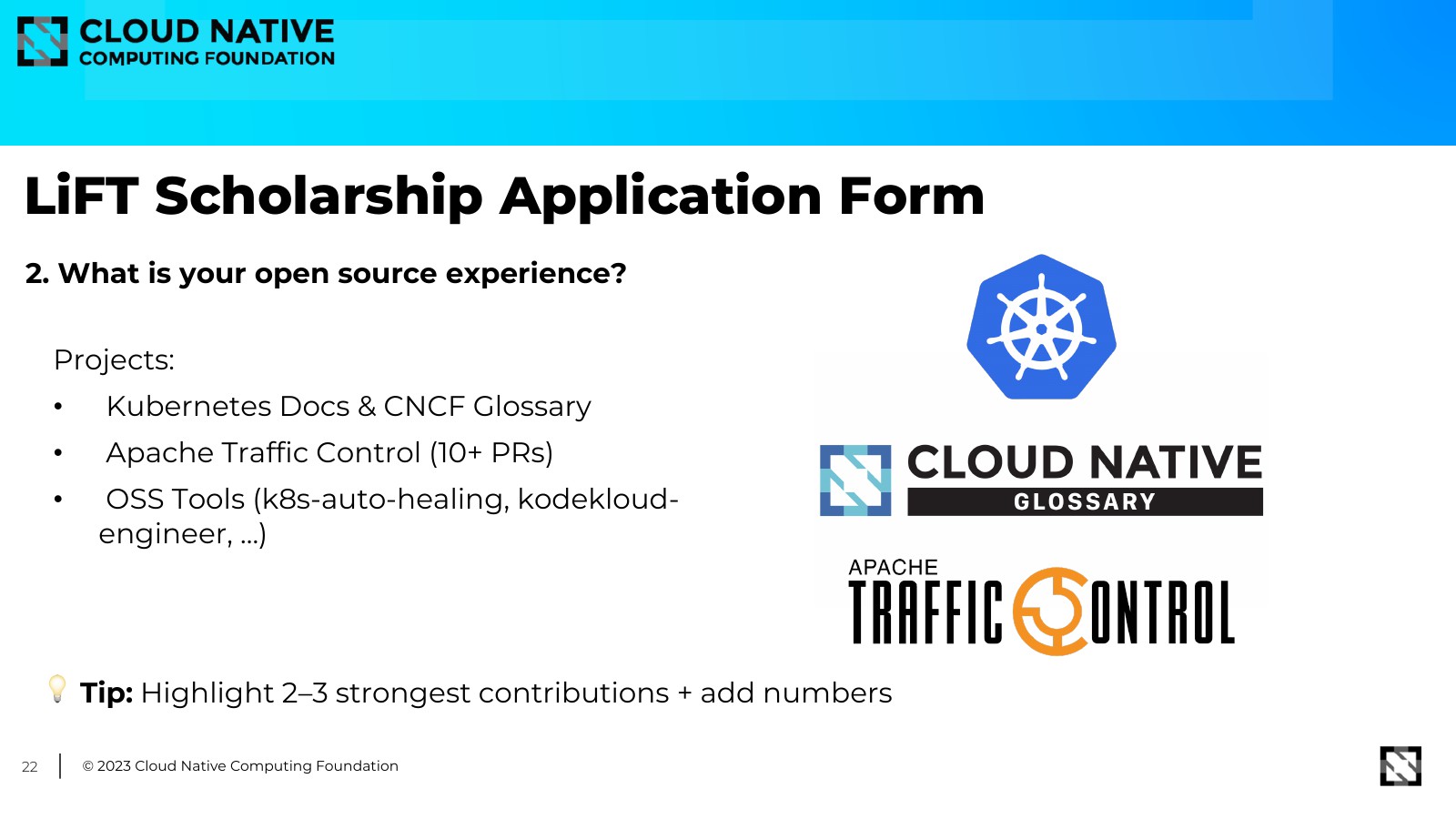
- What is your open source experience? Kubernetes docs and the CNCF Glossary, Apache Traffic Control, and a few tools of my own. Tip: name your two or three strongest contributions, with numbers.
- Why does it matter to your future? Better infrastructure, stronger security, wider collaboration. Tip: link your own growth to what the community gets back.
- How do you use open source in your job? A CDN on Traffic Control, an MLOps platform on Kubeflow, GitOps, monitoring and observability. Tip: be specific about impact: scale, efficiency, cost.
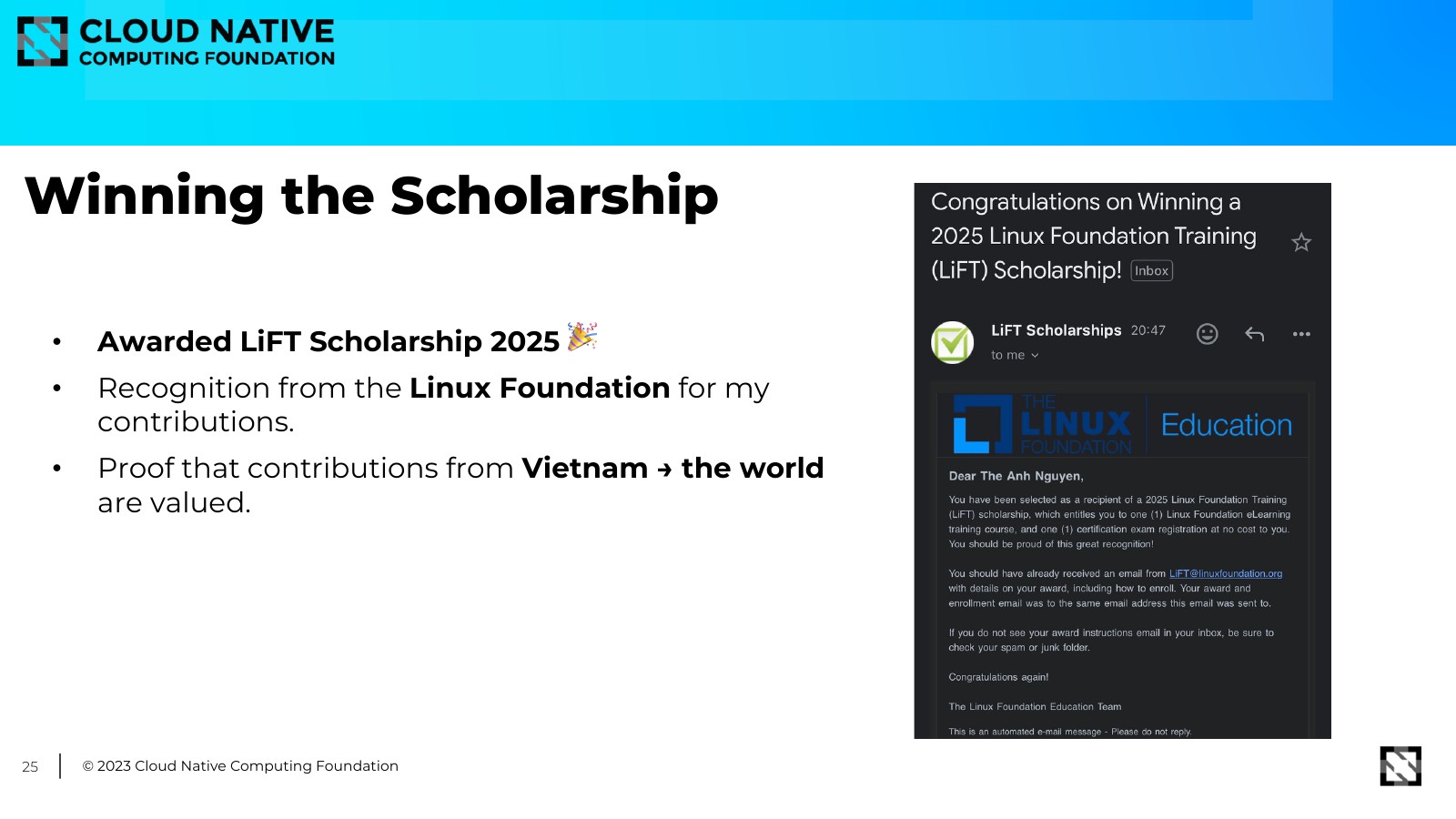
I got it. The award covers one Linux Foundation eLearning course and one certification exam, at no cost. More than the course itself, it was recognition from the Linux Foundation, and proof that a record of small contributions from Vietnam is visible from the other side.
Your turn
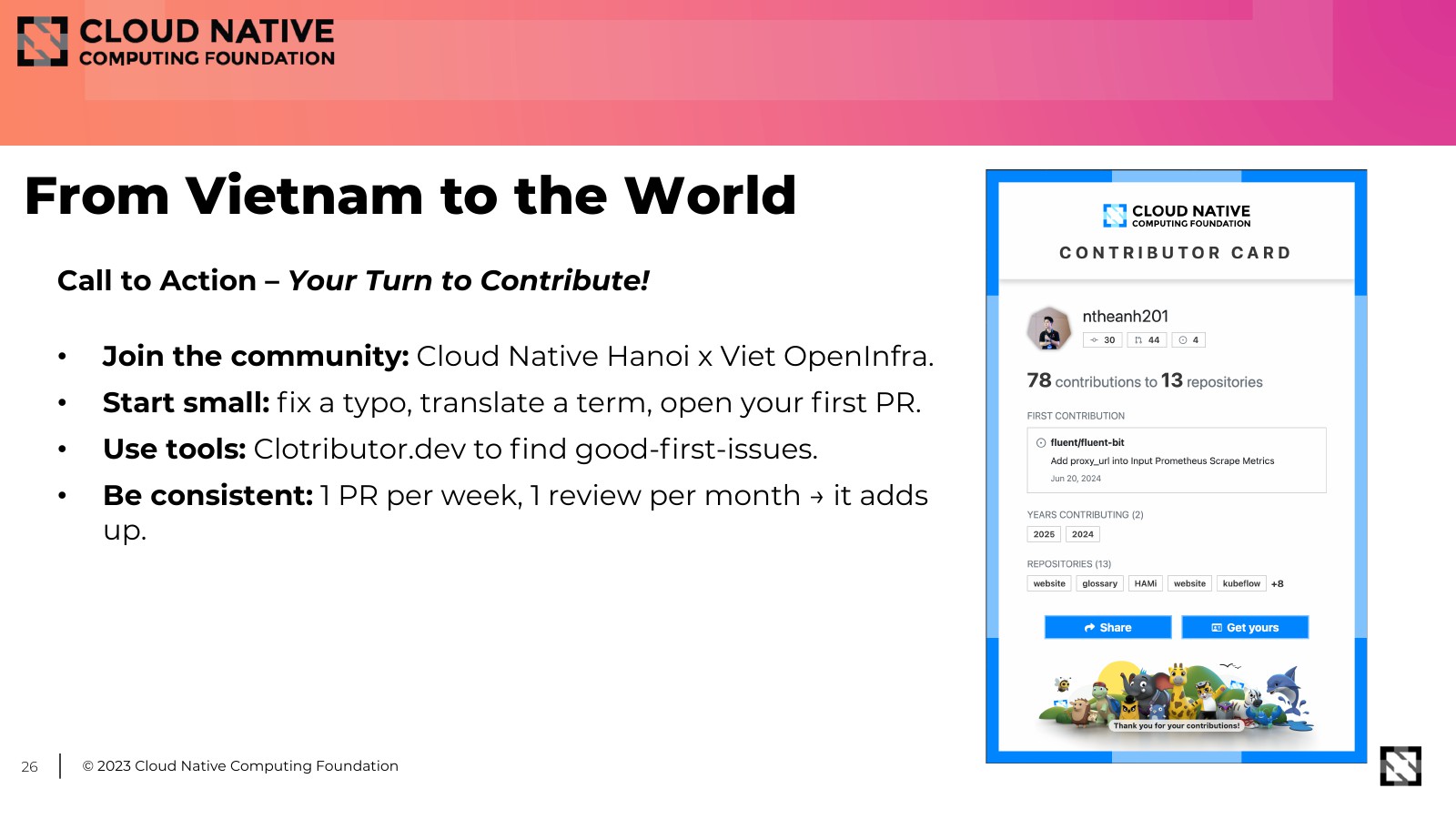
What I asked the room to do is what I’d ask anyone reading this:
- Join the community. Cloud Native Hanoi and VietOpenInfra.
- Start small. Fix a typo, translate one term, open your first PR.
- Use the tools. clotributor.dev finds good first issues.
- Be consistent. One PR a week, one review a month. It adds up.

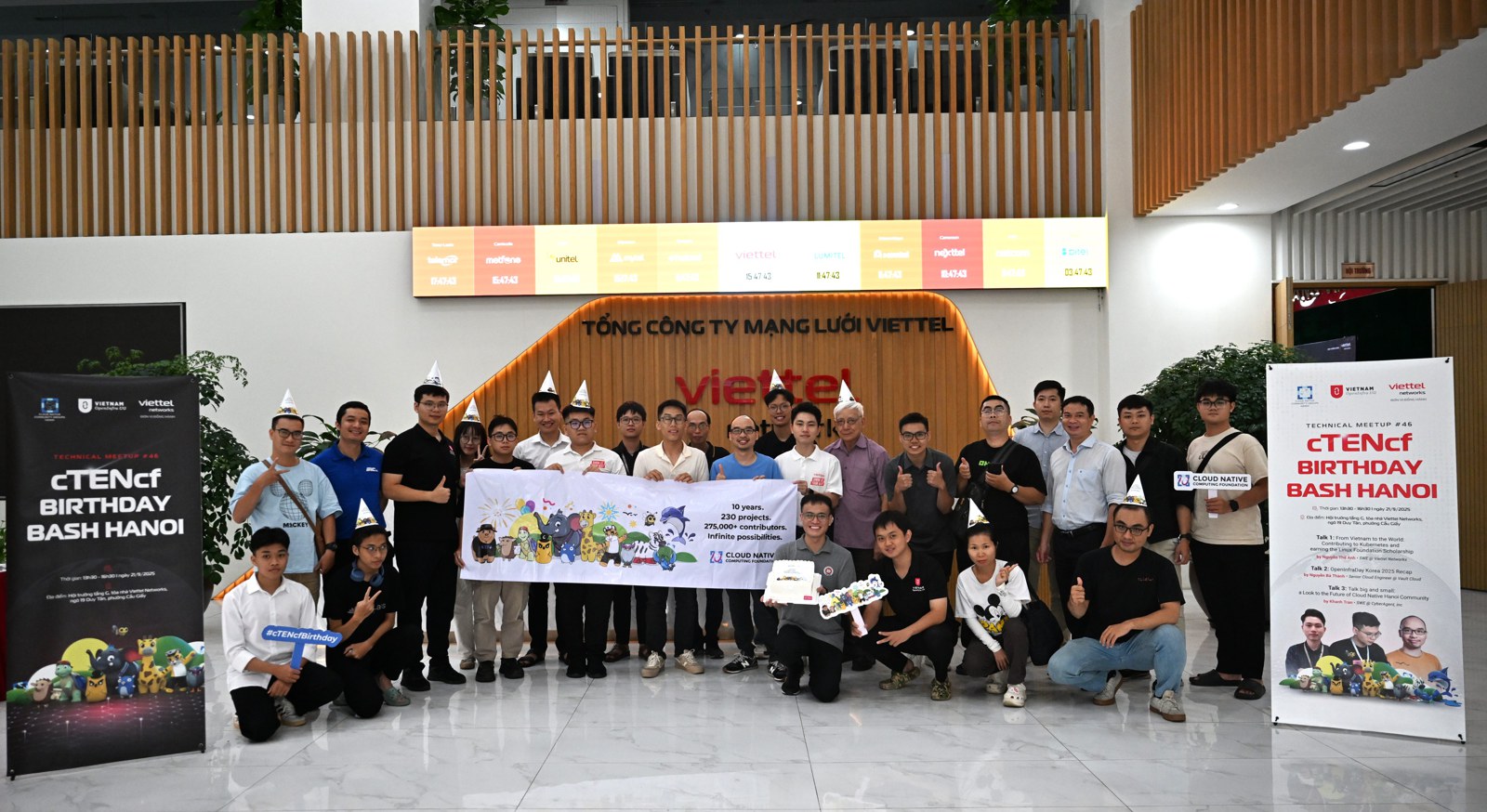
Happy tenth birthday, CNCF. If you open your first Kubernetes docs PR in Vietnamese, tag me. I’m one of the reviewers now.