
Recap KCD & OpenInfra Days Vietnam 2026: From Project to Production, HAMi and Viettel Cloud
3.4× more work per GPU from cards that sat mostly empty, on a certified Kubernetes AI platform. What we measured, what it took, and how to pick the jobs that benefit.
Our GPUs were mostly empty while their pods held the whole card. With HAMi, one H200 did 3.4× the work at the same latency. Getting there took real operations work, and the gain comes from choosing the right jobs to share a card. That was my half of the talk Reza Jelveh and I gave at KCD & OpenInfra Days Vietnam 2026, on 25 July at the Sheraton Hanoi.
The pairing is what made the session work. Reza is a Solution Architect at Dynamia AI, the company behind HAMi, so he brought the upstream view: how the project works and why. I brought the downstream view from our GPU clusters: what we measured, what broke, and what we learned.
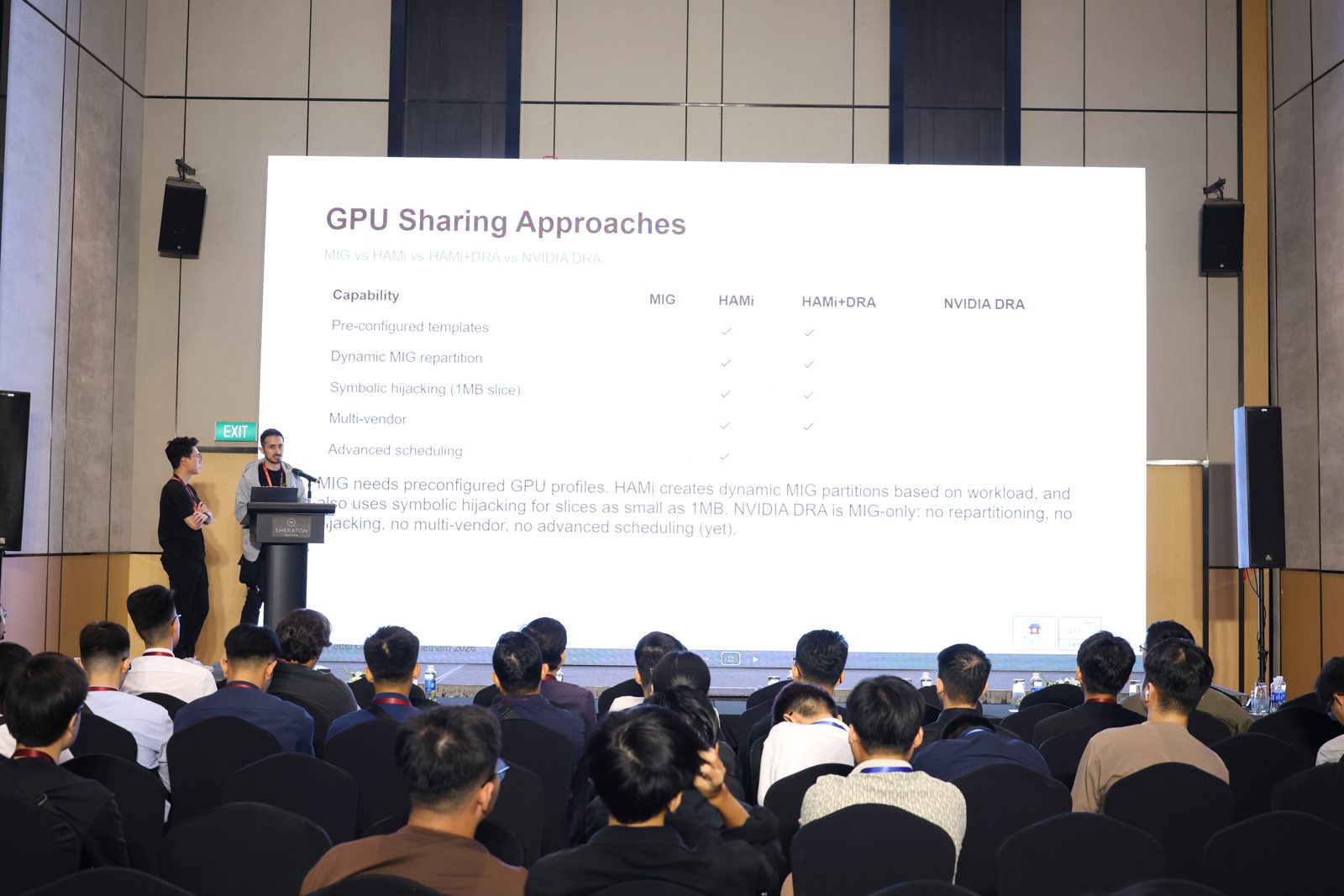
Reza’s half: why GPUs need slicing at all
Kubernetes allocates GPUs atomically. A pod asks for nvidia.com/gpu: 1 and gets the whole device, so a
job that needs 1 GB holds an 80 GB card, and over-provisioning becomes the default. DRA gives Kubernetes
a structured way to describe and request devices, but describing a slice is not the same as enforcing
it.
HAMi, a CNCF Incubating project, fills that gap. It intercepts CUDA calls inside the container
(libvgpu, loaded with LD_PRELOAD) so a pod gets a hard memory limit and a share of compute on a
physical GPU. Reza walked through the rest of the toolbox: binpack, spread and topology-aware
scheduling, memory oversubscription, priority, and support for accelerators beyond NVIDIA such as
Ascend and Cambricon. HAMi also ships a DRA driver, which is where the two approaches meet.
A certified Kubernetes AI platform underneath
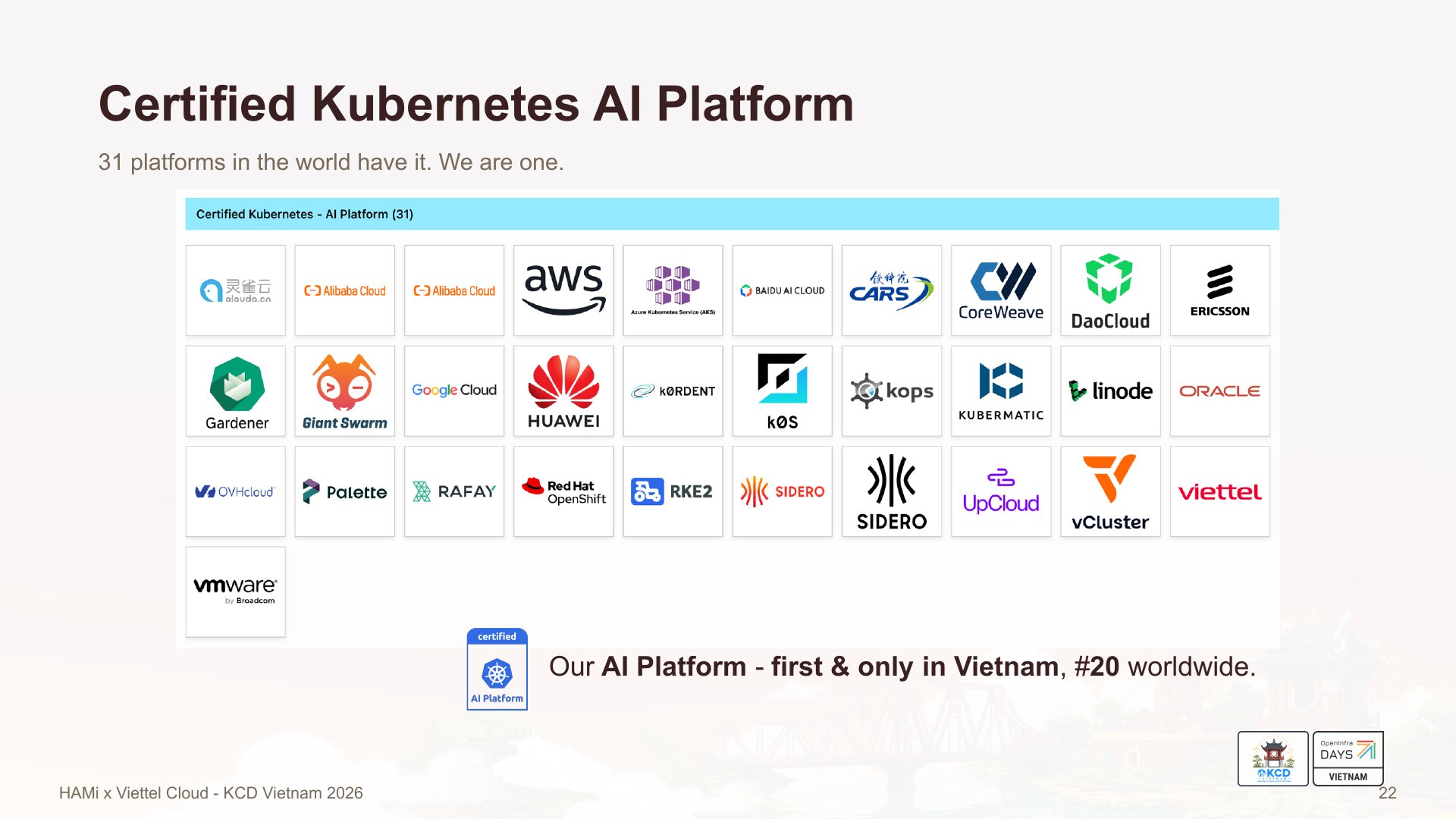
Before the numbers, the platform under them. CNCF’s Kubernetes AI Conformance program certifies that a platform runs AI workloads the standard way: DRA support, gang scheduling, accelerator and AI-service metrics, secure accelerator access, Gateway API for inference, and pod and cluster autoscaling. Our AI platform is certified on Kubernetes v1.35 (conformance submission). At the time of the talk it was one of 31 certified platforms worldwide, next to AWS, Google Cloud, Azure, Oracle and Red Hat OpenShift, and the first from Vietnam.
Two of those requirements are exactly where GPU sharing gets tested. Accelerator access has to stay secure when several pods share one card, and accelerator metrics have to work per pod, not only per physical GPU.
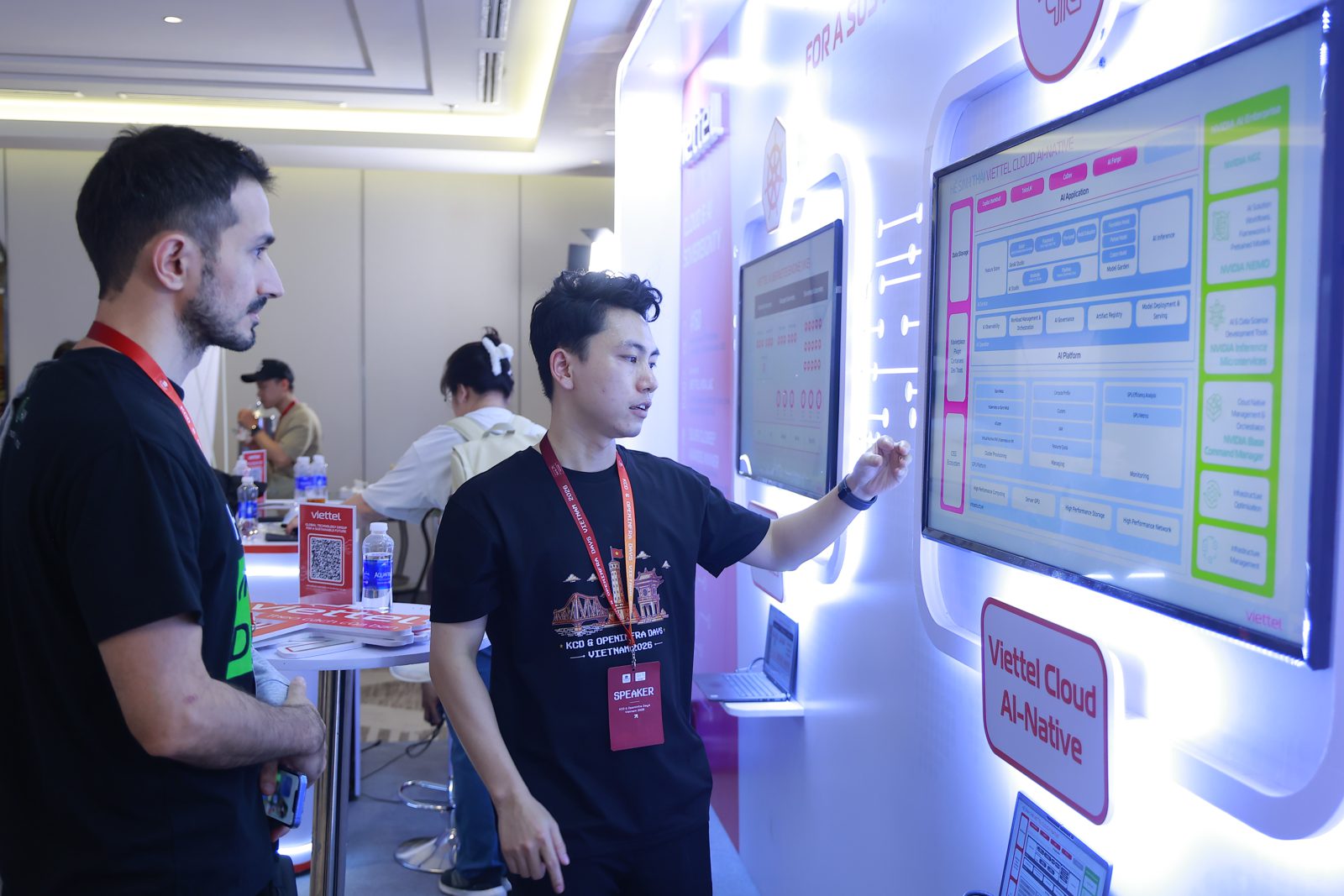
Showing Reza the Viettel AI Platform (Viettel Cloud AI-Native) at the booth.
What we run
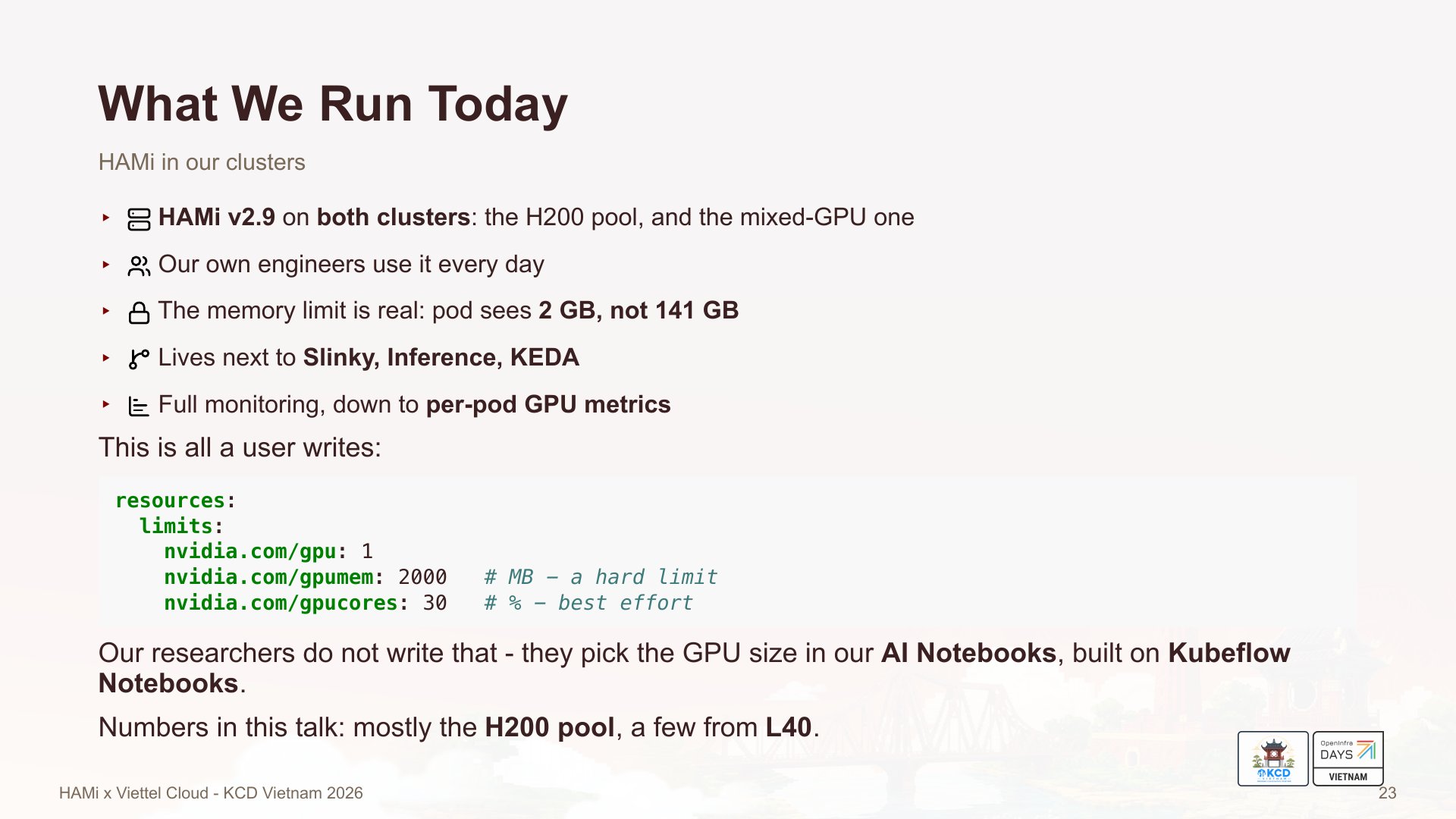
HAMi 2.9 runs on both of our clusters: an H200 pool, and a pool of mixed GPUs (L40, L40S, A30, A6000). It
sits next to Slinky, inference workloads and KEDA, with two schedulers side by side. The memory limit is
real: inside a pod with a 2 GB slice, nvidia-smi shows 2 GB, not 141. This is all a user writes:
resources:
  limits:
    nvidia.com/gpu: 1
    nvidia.com/gpumem: 2000   # MB, a hard limit
    nvidia.com/gpucores: 30   # %, best effort
Most researchers never write even that. They pick a GPU size in a notebook UI built on Kubeflow Notebooks. We also monitor per-pod GPU usage, which DCGM alone can’t give you, since it reports per physical GPU. Most numbers below come from the H200 pool, a few from L40.
The problem, measured
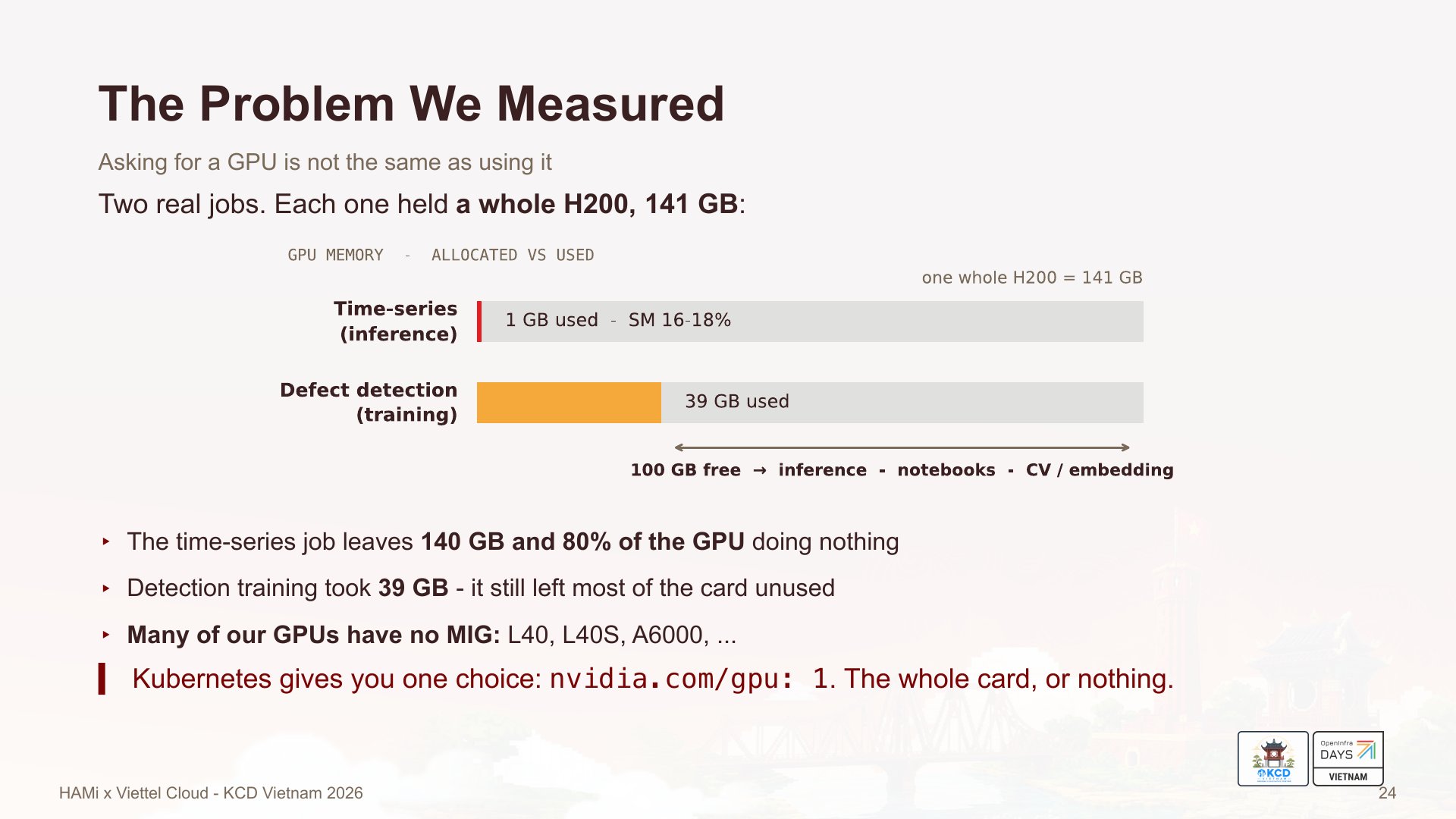
Two real jobs, each holding a whole H200 with 141 GB:
- Time-series forecasting with Chronos, a foundation model of about 200M parameters, predicting infrastructure load and telemetry. It used 1 GB of 141, and 16 to 18% of compute.
- A training job in a notebook: YOLO11 on about 17,000 high-resolution photos, detecting damage on electrical cabinets. It used 39 GB.
Someone always asks why only 39. The batch size is picked for accuracy, not memory: it’s a small model at high resolution, and a bigger batch makes the mAP worse. The model is already busy about 90% of the time, and pushing further makes the data pipeline the bottleneck long before VRAM fills. So 39 GB is the right size, and the other 100 GB really is spare.
The part people forget: L40, L40S and A6000 have no MIG. Hardware slicing isn’t an option on most of that fleet. Kubernetes alone gives one answer, the whole card or nothing.
3.4× more work per GPU
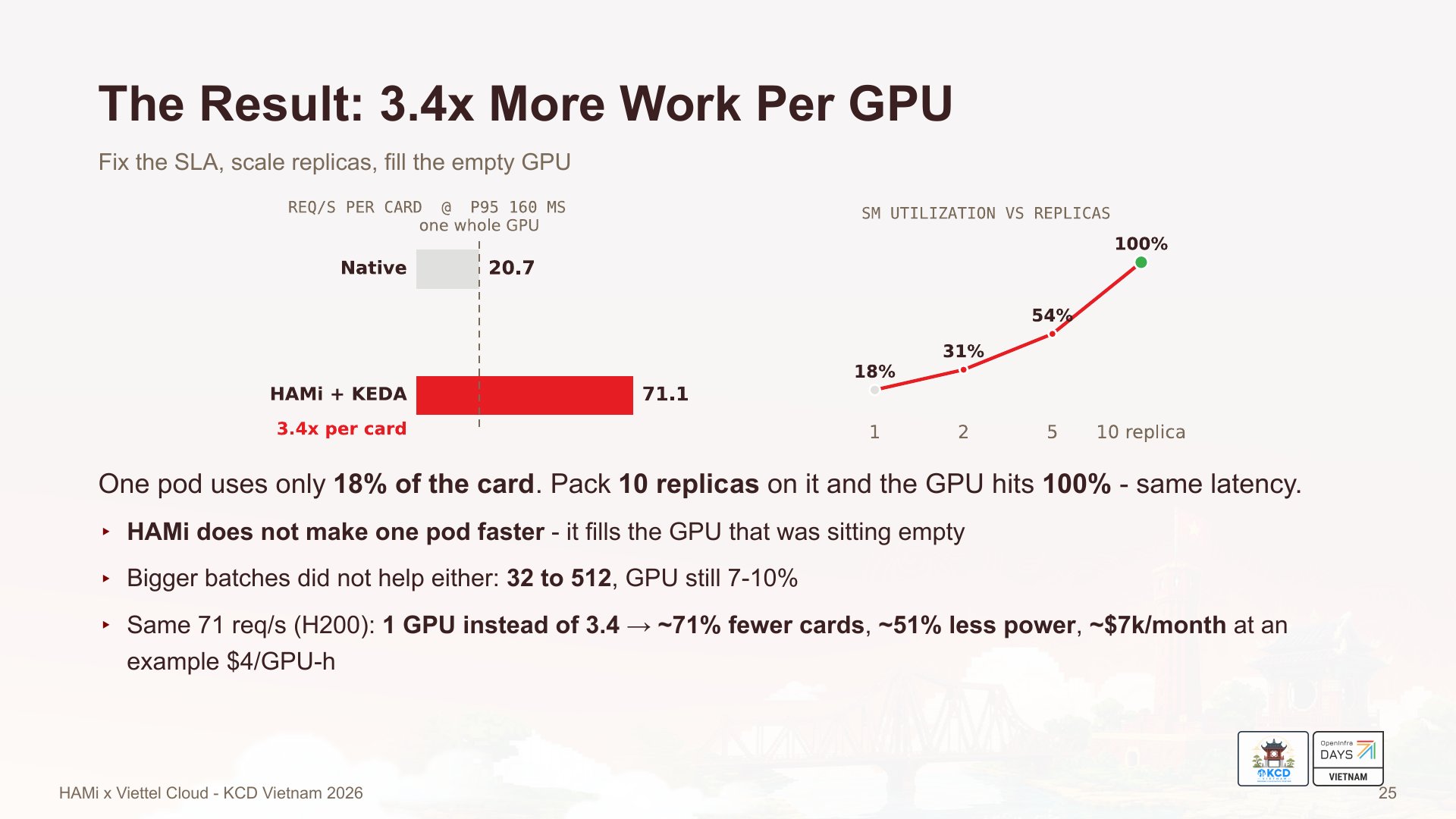
Same GPU, same Chronos job, same latency target:
| Setup | Requests/s at P95 160 ms | GPU (SM) used |
|---|---|---|
| One pod, whole card | 20.7 | 18% |
| One pod, HAMi slice | 19.6 | n/a |
| HAMi + KEDA, scale replicas | 71.1 | 100% at 10 replicas |
HAMi doesn’t make one pod faster. It fills the GPU that was sitting empty. Serving 71 req/s natively would take about 3.4 cards; here it takes one. That’s about 71% fewer cards, and by our measured wattages about half the power.
When I showed this to my team, the first reply was that the baseline wasn’t fair. So we went back and tried three things. With no latency limit at all, one pod topped out at 29.6 req/s, with P95 going from 57 ms to 6.2 s and the GPU still around 10%. Batch size from 32 up to 512 left the GPU at 7 to 10%. TF32, bfloat16 autocast and dtype changes did nothing. One instance of this model can’t fill an H200, however you tune it.
Reserving space costs time, on purpose
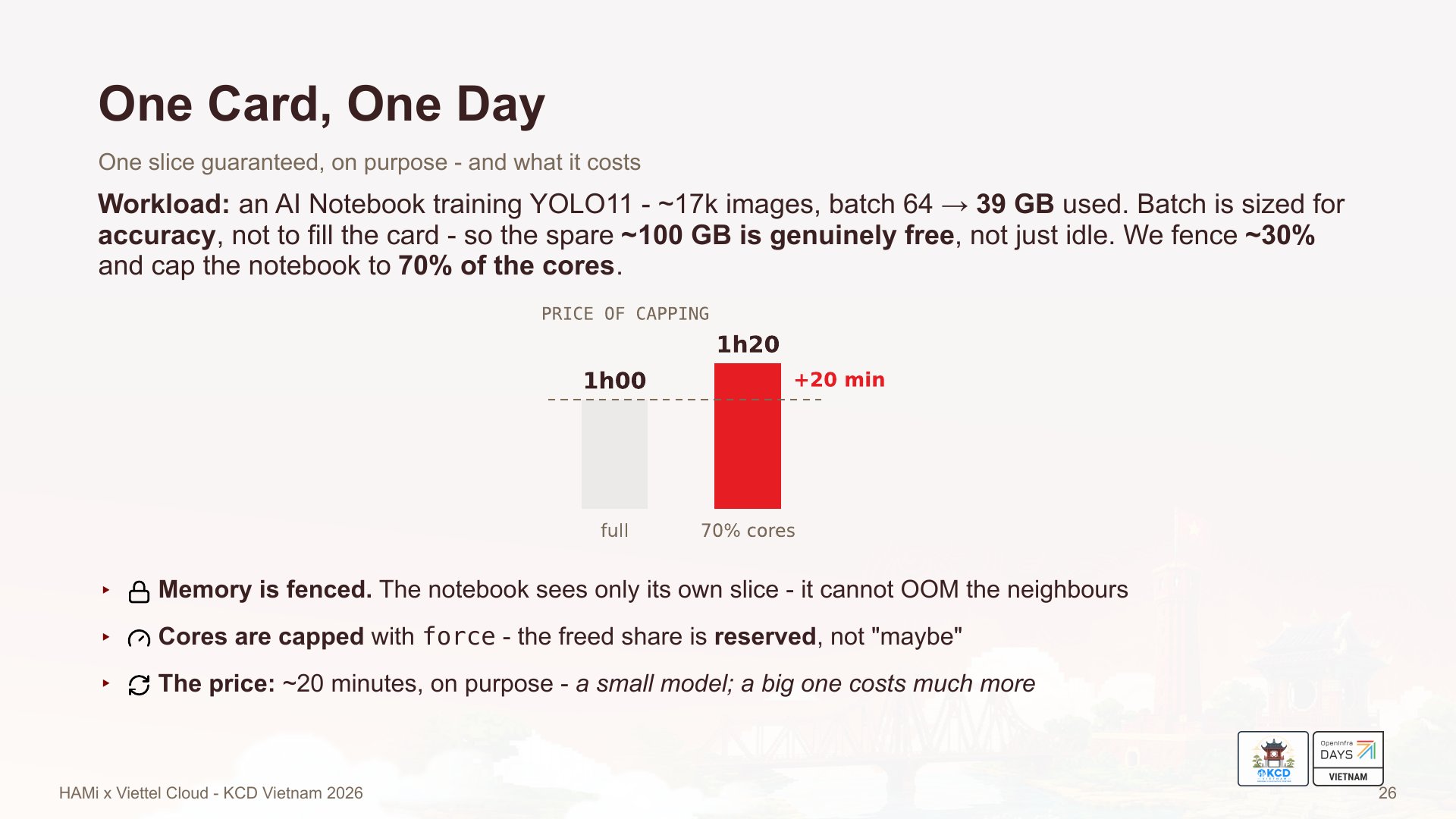
The spare space goes to whatever needs it: small LLMs, agents, vision and embedding jobs. To make that space real rather than “free if training happens to be idle”, we cap the notebook:
- Memory is fenced. The notebook sees only its slice and can’t OOM its neighbours.
- Cores are capped with
force, at 70%, so the rest of the card is actually reserved. - That costs about 20 minutes. One training run goes from 1 h to 1 h 20. Cheap for a small model, much less cheap for a big one.
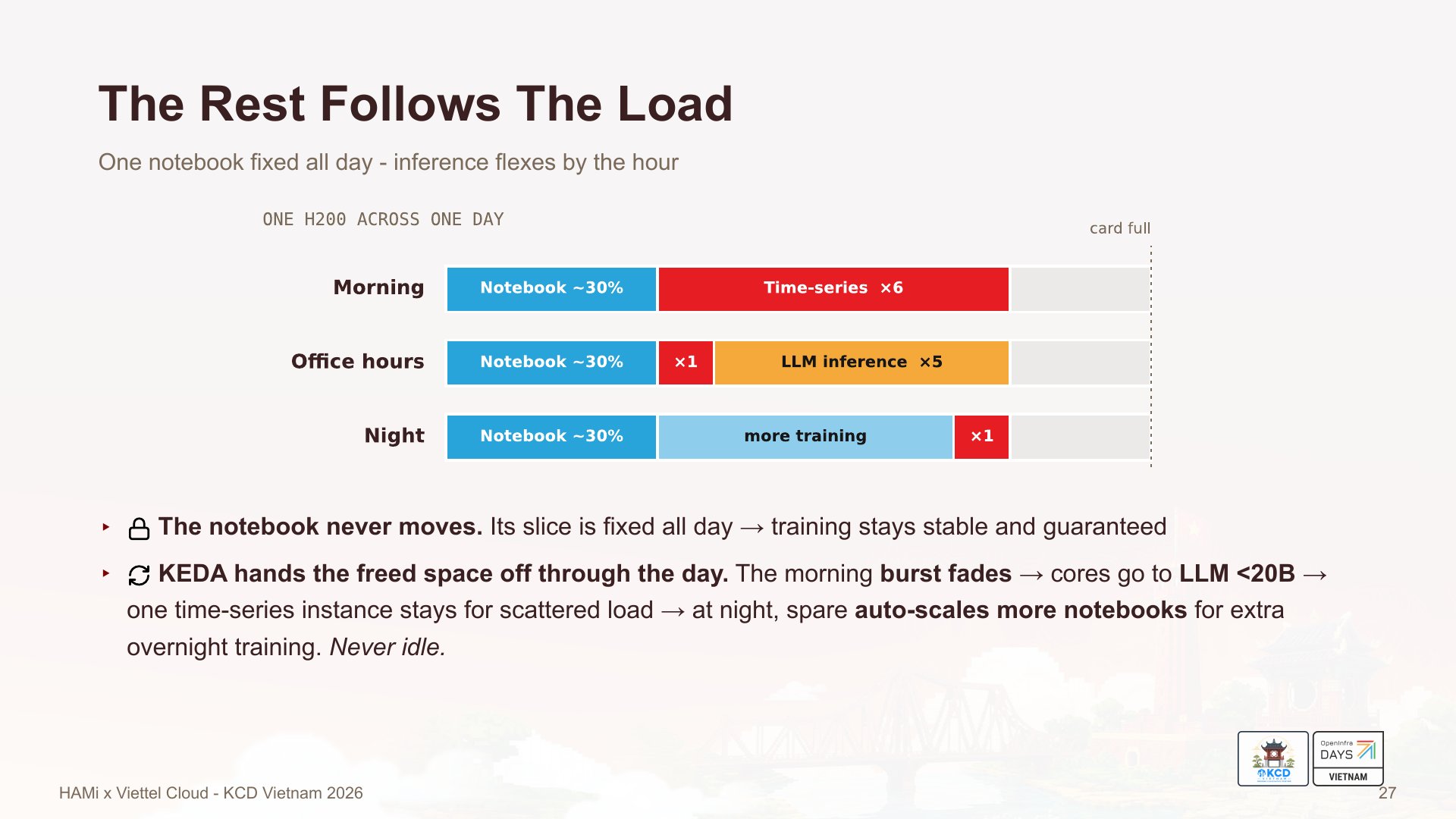
Across a day the notebook block never changes, and everything else follows the load. Early morning, forecasts burst to six instances. Office hours, LLM inference on models under 20B takes the space. Overnight, more notebooks and training run instead of the card sitting idle.
Pick the jobs that benefit
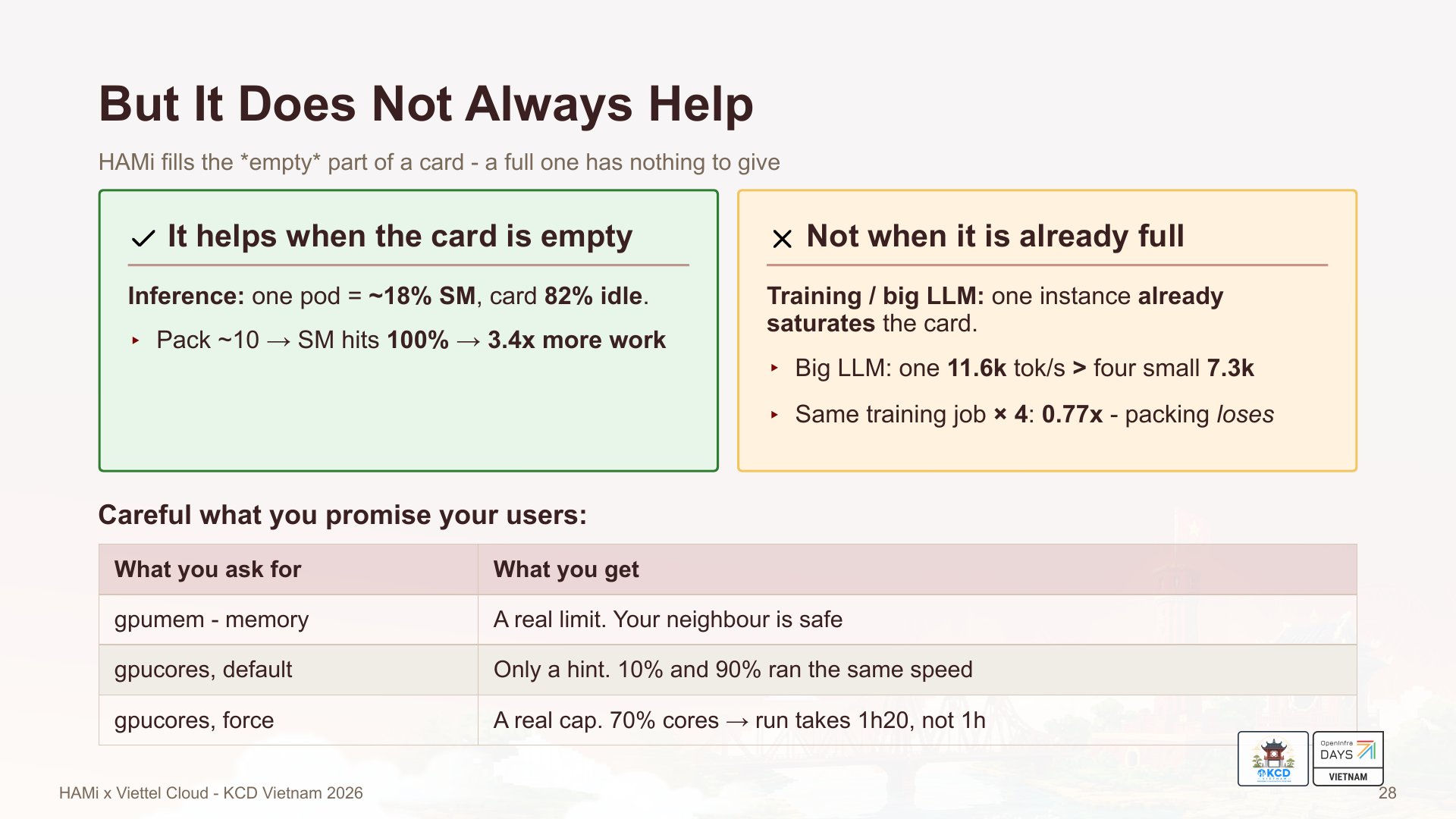
This is the slide I’d keep if I could keep one. Fractional GPU helps when a job is small or bursty and can’t fill the card alone. It doesn’t help when the job already fills the GPU, and we measured that twice:
- LLM serving. SGLang on one H200: one big instance gave 11.6k tokens/s, four small ones gave 7.3k. Continuous batching already keeps the GPU busy.
- Training. The same LSTM job packed 1, 2 and 4 times on one card: 2,779, then 2,278, then 2,148 samples/s in total. At 4×, that’s 0.77 of a single job.
When the card is already full, packing buys isolation and fair share, not throughput.
Be careful what you promise users, too. gpumem is a real limit. gpucores is a hint: two pods given
10% and 90% of the same card ran the same workload at the same speed, about 11 ops/s each. Under
contention it becomes fair share. With force the cap becomes real, at the cost we just saw. Promise
memory; don’t promise compute.
What it really took
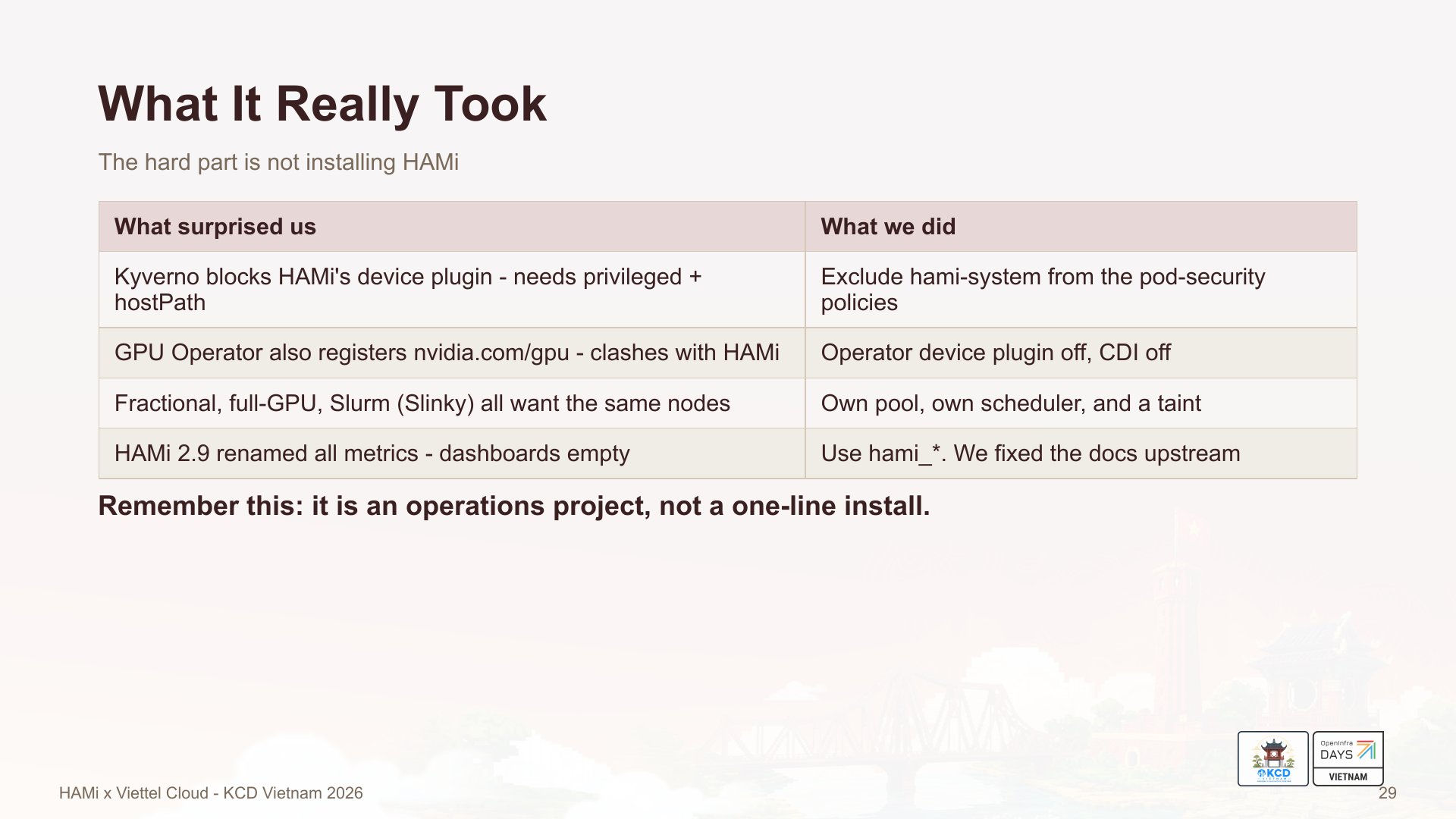
The Helm chart was the easy part.
- Kyverno blocked HAMi. Its device plugin needs host paths, the driver and a kubelet socket, so it
runs privileged. Our policies reject exactly that, so we added an exception for the
hami-systemnamespace only. - The GPU Operator also registers
nvidia.com/gpu. We turned off the operator’s device plugin, and turned CDI off: in CDI mode the toolkit wires devices its own way, and HAMi’s library needs the legacy runtime path. - Fractional pods, full-GPU pods and Slinky fought over nodes. HAMi got its own pool, its own scheduler and a taint.
- HAMi 2.9 renamed every metric, and our dashboards went empty. We moved to the new names and sent the docs fix upstream (website#498).
If you remember one thing: this is an operations project, not a one-line install.
Where the magic breaks
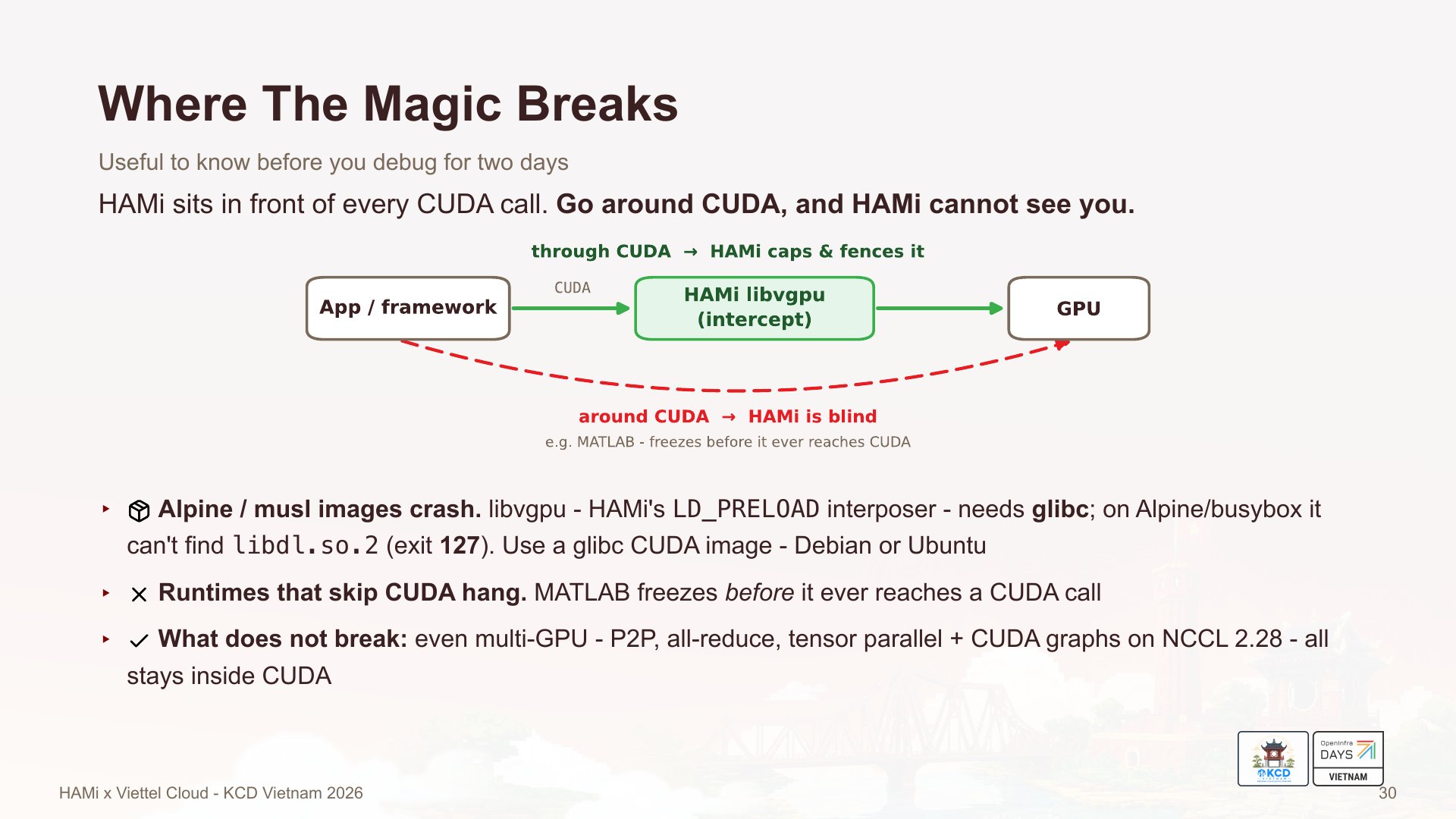
HAMi sits in front of every CUDA call, so anything that goes around CUDA is invisible to it. What stays inside CUDA held up, multi-GPU included: peer-to-peer, all-reduce and tensor parallel with CUDA graphs all passed on NCCL 2.28, and so did an old NCCL forced onto the legacy path.
Two things did break. A musl image (Alpine, busybox) can’t load libvgpu, which needs glibc: the
container dies with libdl.so.2 not found and exit code 127 before your code runs. The fix is a glibc
base image. And MATLAB froze before it ever reached a CUDA call, because HAMi waits at the CUDA
layer and MATLAB never gets there.
What’s next
More GPU pools, more kinds of workload sharing a card, and a move to DRA: the same isolation, requested the standard Kubernetes way instead of through a custom resource name. And the reason we picked HAMi in the first place is multi-vendor. Our GPUs won’t always be NVIDIA, and HAMi already supports Ascend, Cambricon and others.
Further reading
- HAMi on GitHub, and the project site.
- A few weeks later, HAMi recognized my contributions to the project with a Contributor Recognition.
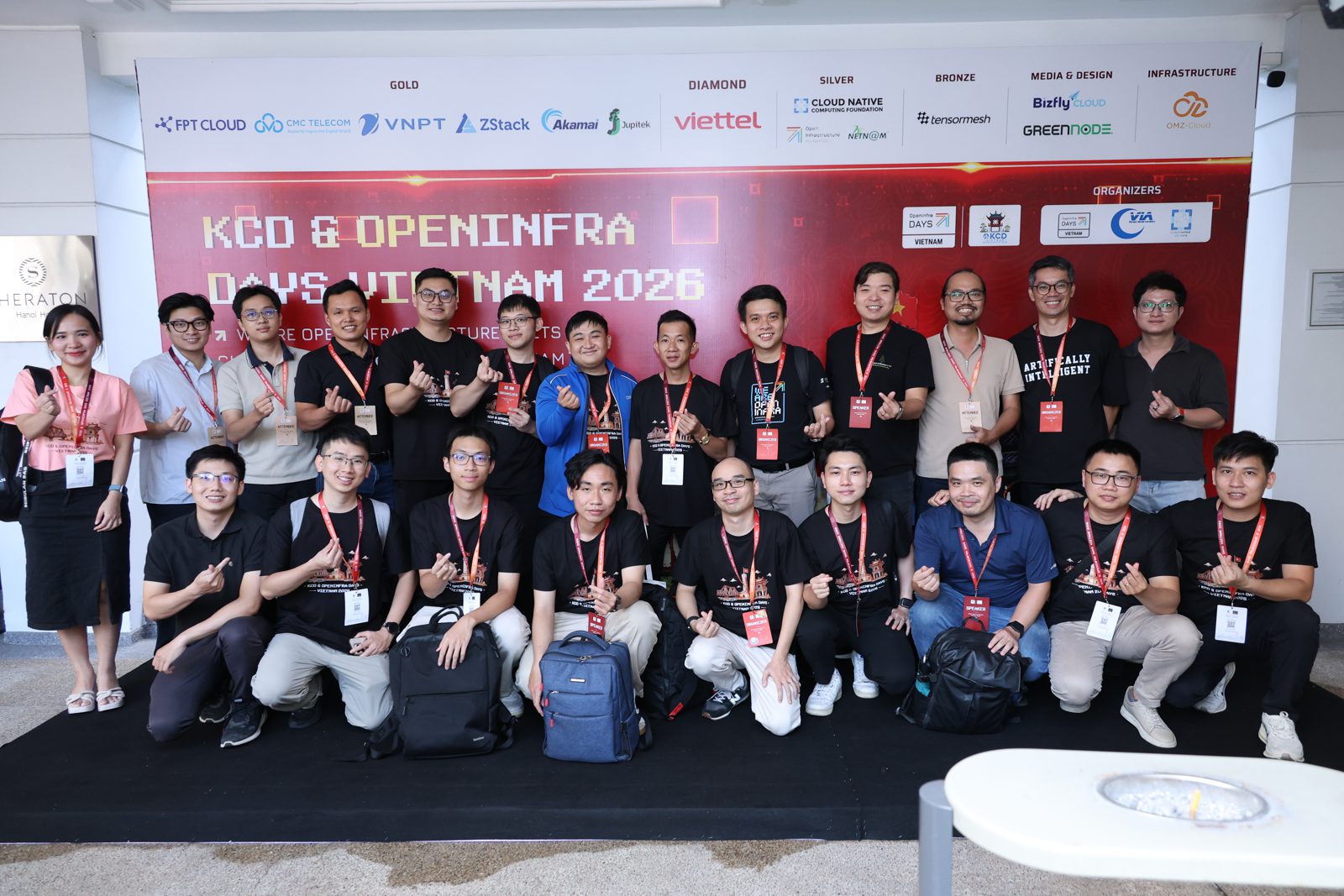
Thanks to Reza for sharing the stage, to the HAMi maintainers, and to the KCD & OpenInfra Days Vietnam organizers.
Fractional GPU turned cards that sat mostly empty into 3.4× the work. The craft is in knowing which jobs leave the card empty, and running the platform so they can share it safely. If you’ve run HAMi or DRA on your own GPUs and found the line somewhere else, I’d like to hear about it.